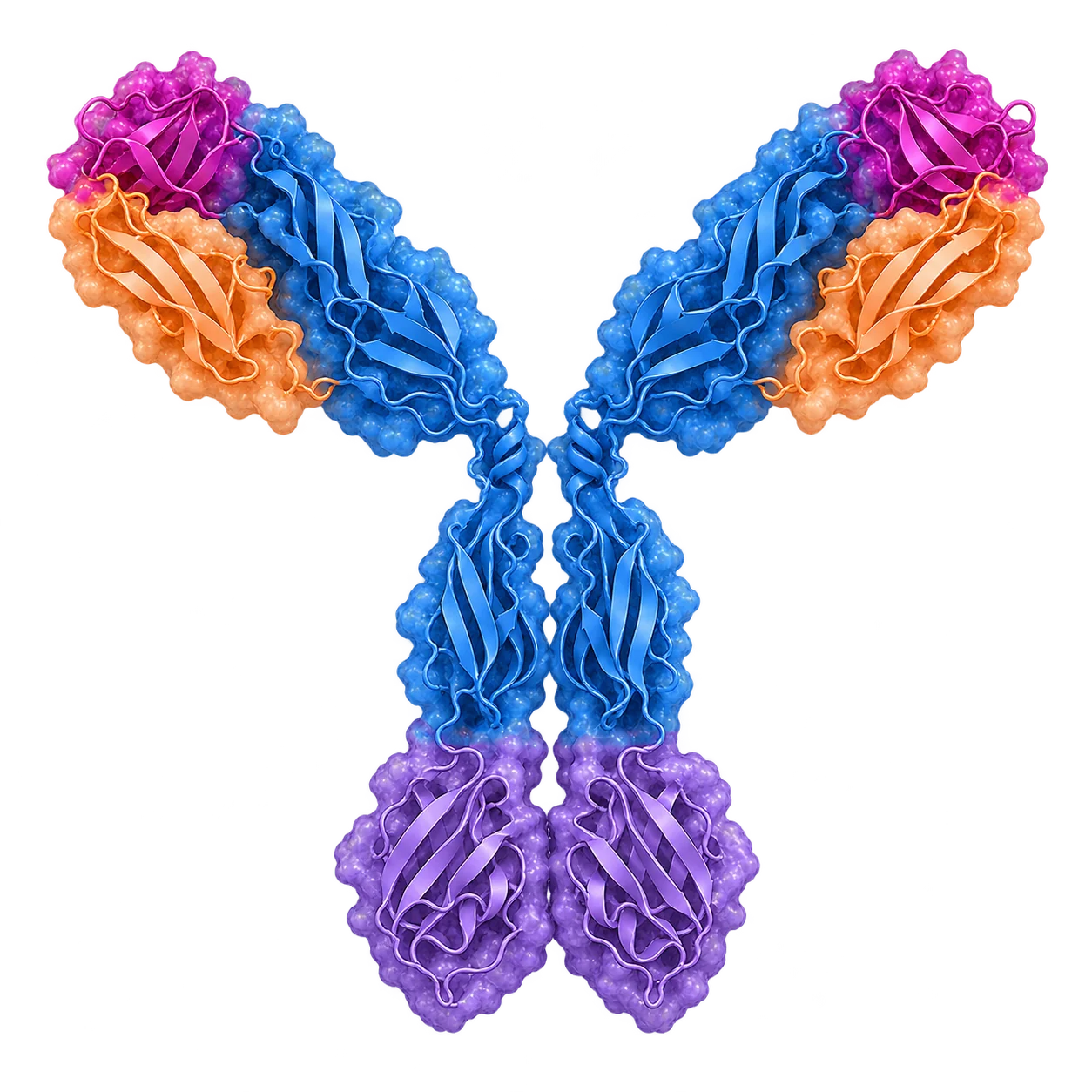
Antibodies recognize, neutralize and help eliminate threats.
Immunoglobulins (antibodies) are specialized proteins produced by B cells that recognize specific antigens, such as viruses, bacteria or toxins. They are a key component of adaptive immunity and play essential roles in protection, immune memory and vaccination.
A family of antibodies with specialized functions.
Immunoglobulins (Ig) are Y-shaped proteins produced by B cells and plasma cells. Each antibody is designed to recognize a specific antigen. Different antibody classes (IgG, IgM, IgA, IgE and IgD) work together to provide protection in different tissues and situations.
Variable domains at the arm tips determine antigen specificity.
3
Light chain
The shorter outer chain includes a variable domain and a constant domain.
4
Heavy chain
The longer chain forms the inner arms and stem of the antibody.
5
Constant region
Constant domains contribute to antibody class and function; the lower stem is the Fc region.
Antigen-binding site(recognizes a specific antigen)
Variable region(determines specificity)
Light chain
Heavy chain
Constant region(defines antibody class and function)
Key Functions
Neutralize pathogens and toxins
Mark targets for elimination
Activate the immune system (complement, Fc receptors)
Support lasting antibody protection
Maintain immune homeostasis
The Five Antibody Classes
Each immunoglobulin class has unique properties and functions.
IgG
The most abundant in blood
Most abundant antibody in circulation
Long-lasting protection
Crosses the placenta (protects newborns)
Important in responses to infections and vaccines
IgM
The first responder
First antibody produced during a new infection
Very effective at activating complement
Often appears early in a response; persistence varies
Secreted IgM is predominantly pentameric; membrane IgM is monomeric
IgA
Protection at body surfaces
Found in mucosal secretions (saliva, tears, gut, respiratory tract, breast milk)
Helps prevent pathogen entry
Exists as a dimer in secretions
Important for mucosal immunity
IgE
Defense and allergy
Involved in defense against parasites (e.g. helminths)
Binds to mast cells and basophils
Mediates allergic reactions
Present at low levels in blood
IgD
Still being discovered
Mainly found on the surface of naïve B cells
May play a role in B-cell activation and regulation
Present at very low levels in blood
Functions are still under investigation
How Antibodies Work
Multiple mechanisms, working together.
Neutralization
Block viruses, bacteria or toxins from entering cells.
Opsonization
Coat pathogens to make them easier to engulf by immune cells (e.g. macrophages).
Complement activation
Trigger a cascade of proteins that help destroy pathogens.
Antibody-dependent cellular cytotoxicity (ADCC)
Recruit natural killer (NK) cells and other immune cells to eliminate infected or abnormal cells.
Antibodies and Vaccines
Vaccines train your immune system to make better antibodies.
B cells are activated
Plasma cells produce antibodies
Memory B cells provide long-term protection
Vaccines expose the immune system to antigens or instructions for producing an antigen, helping the body produce high-affinity antibodies and long-lived memory B cells. This prepares the immune system for a faster and stronger response upon future exposure.
 Subscribe