Skip to content

Immune Aging

Your Immune System Changes With You

Aging does not simply weaken immunity. It remodels it.

With age, the production and composition of immune cells change, immune diversity can decrease, immune communication is altered and inflammatory regulation shifts. These changes are influenced by genetics, lifelong exposures, lifestyle and health status, and vary greatly between individuals.

Explore immune aging →
A lifetime
of experience.
A changing
immune system.
A healthier
tomorrow.
A lifetime of experience.
A changing immune system.
A healthier tomorrow.

Reduced thymic output

Remodeling of T & B cells

Changes in innate immunity

Increased low-grade inflammation

The Two Faces of Immune Aging

Aging reshapes the immune system in two interconnected ways.

IMMUNOSENESCENCE

Some immune responses become less effective

↓ Naïve T-cell production

Altered T-cell responses

Altered B-cell responses

Changes in innate immunity

Reduced vaccine responses

With age, the immune system can be less efficient at recognizing and responding to new challenges, with reduced thymic output, contraction of naïve T cells, remodeling of T and B cells, and functional changes in innate immune cells.

Explore Immunosenescence →
THE IMMUNE
AGING PARADOX
Less effective
when protection
is needed.

More inflammatory
when inflammation
is not needed.

INFLAMMAGING

At the same time, inflammatory activity can increase

Senescent cells (SASP)

Altered cytokine networks

Cellular damage

Microbiome and barrier changes

Impaired resolution of inflammation

Aging can be accompanied by persistent, low-grade inflammation in the absence of an acute infection. Multiple factors contribute, including cellular senescence, metabolic changes, chronic infections, dysbiosis and tissue damage.

Explore Inflammaging →

What Changes With Age?

Immune aging affects cells, organs and the environments in which they function.

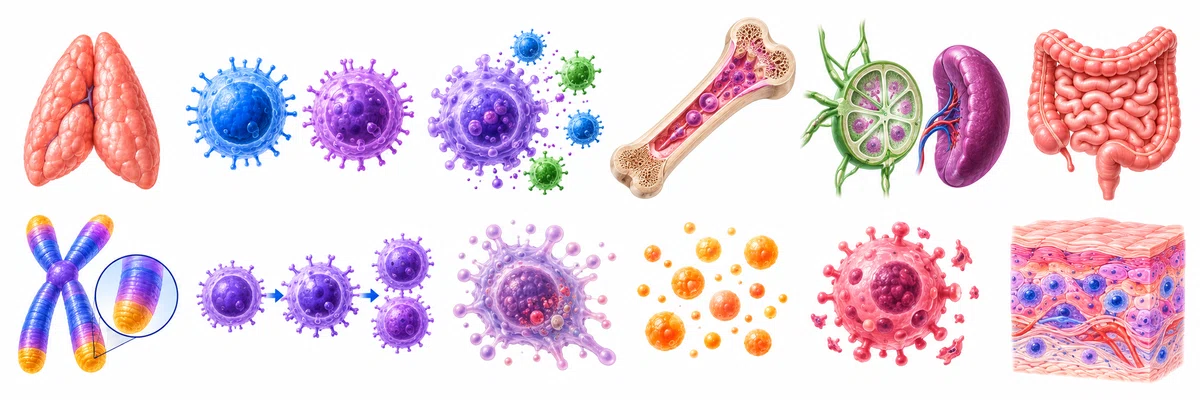
1. Thymus

  • Involution with age
  • ↓ new naïve T cells
  • Altered T-cell repertoire

2. T & B Cells

  • ↓ naïve T cells
  • More memory/differentiated T cells
  • Altered B-cell function and antibody responses

3. Innate Immunity

  • Changes in neutrophils, monocytes, macrophages, dendritic cells and NK cells
  • Altered pathogen sensing and cytokine production

4. Bone Marrow

  • Aging of hematopoietic stem cells (HSCs)
  • Altered hematopoiesis
  • Increased clonal hematopoiesis (CH)

5. Immune Tissues

  • Structural remodeling of lymph nodes and spleen
  • Altered stromal support and chemokine networks
  • Changes in tissue microenvironments

6. Gut & Barriers

  • Altered microbiome composition
  • Increased intestinal permeability
  • Changes in mucosal immunity
  • Interaction with systemic inflammation

Telomeres & Immune Aging

Telomeres protect chromosome ends, but shorten with repeated cell division.

Chromosome

Telomere
(protects DNA ends)

With repeated cell division:

Naïve T cell
(long telomeres)
After repeated
divisions
(shorter telomeres)
Highly differentiated
T cell
(critically short)

Science Check

Telomere length is one piece of immune-aging biology — not a stand-alone immune-age test.

Telomeres shorten in many immune-cell populations with age and repeated proliferation. Critically short telomeres can limit immune-cell function, but immune aging is multifactorial and cannot be captured by telomere length alone.

Immunosenescence and Inflammaging Can Reinforce One Another

Cellular stressand damageSenescent cellsand inflammatorysignalsChronic low-gradeinflammationAltered immune-cell functionImpaired surveillanceand tissue repairAdditionalcellular damageAn interconnectedcycle(not an inevitablefixed sequence)

Immunosenescence

Changes in immune-cell function can reduce effective surveillance, clearance and tissue repair.

Can reinforce one another

Inflammaging

Persistent inflammatory signals can alter immune-cell function and contribute to cellular stress and tissue damage.

Cellular damage, senescent cells and impaired repair can contribute to this feedback. The relationship varies between individuals; it is not an inevitable, fixed sequence.

Why Immune Aging Matters

Age-related immune changes can influence health throughout life.

Infection susceptibility

(e.g., respiratory, viral, bacterial)

Vaccine responsiveness

(magnitude and duration)

Inflammatory environment

(chronic low-grade inflammation)

Tissue repair and recovery

after injury

Immune surveillance

(against abnormal cells)

Age-related diseases

(e.g., cardiovascular, metabolic, neurodegenerative)

Not Everyone’s Immune System Ages at the Same Rate

Age 65

Healthier
immune profile

  • More naïve T cells
  • Lower inflammation
  • Better vaccine response

Chronological age

≠Immune ageSame age.
Different immune systems.
Different tomorrows.

Age 65

More signs
of immune aging

  • Fewer naïve T cells
  • Higher inflammation
  • Weaker vaccine responses

Multiple factors influence
immune aging:

  • Genetics
  • Infection history (e.g., CMV)
  • Lifestyle (diet, exercise, sleep)
  • Metabolic health
  • Medications
  • Chronic diseases
  • Environment and exposures

Can We Measure Immune Aging?

Immune age is multidimensional. No single test tells the whole story.

T-cell composition and repertoire

B-cell compartment and antibodies

Innate immune phenotype & function

Inflammatory mediators (e.g., CRP, IL-6)

Functional responses (e.g., after vaccines)

Telomere biology (cell-specific)

Hematopoietic and biological context

What Can We Influence?

Some factors are established, others are promising, and many claims lack evidence.

✓ESTABLISHED

  • Vaccination (enhanced strategies for older adults)
  • Regular physical activity (overall health benefit)
  • Healthy diet and weight management
  • Adequate sleep

!PROMISING
(UNDER INVESTIGATION)

  • Exercise and specific immune endpoints (mixed results)
  • Caloric restriction (e.g., CALERIE)
  • mTOR/TORC1 modulation (clinical trials)
  • Microbiome-targeted approaches

×HYPE / NOT ESTABLISHED

  • “Boost your immune system”
  • Reverse immune aging with one supplement
  • Lengthen telomeres to rejuvenate immunity
  • One biomarker gives your exact immune age

Don’t aim for the strongest immune system.
Aim for a well-regulated immune system.

Recognize
(threats)

Respond
(effectively)

Coordinate
(recruit the right cells)

Regulate
(prevent overreaction)

Resolve
(turn off inflammation)

Repair
(restore tissues)

Remember
(long-term protection)

Adapt
(to new challenges)

Selected sources and references

Artwork illustrates the main mechanisms schematically; molecular sizes, colors and distances are not literal.